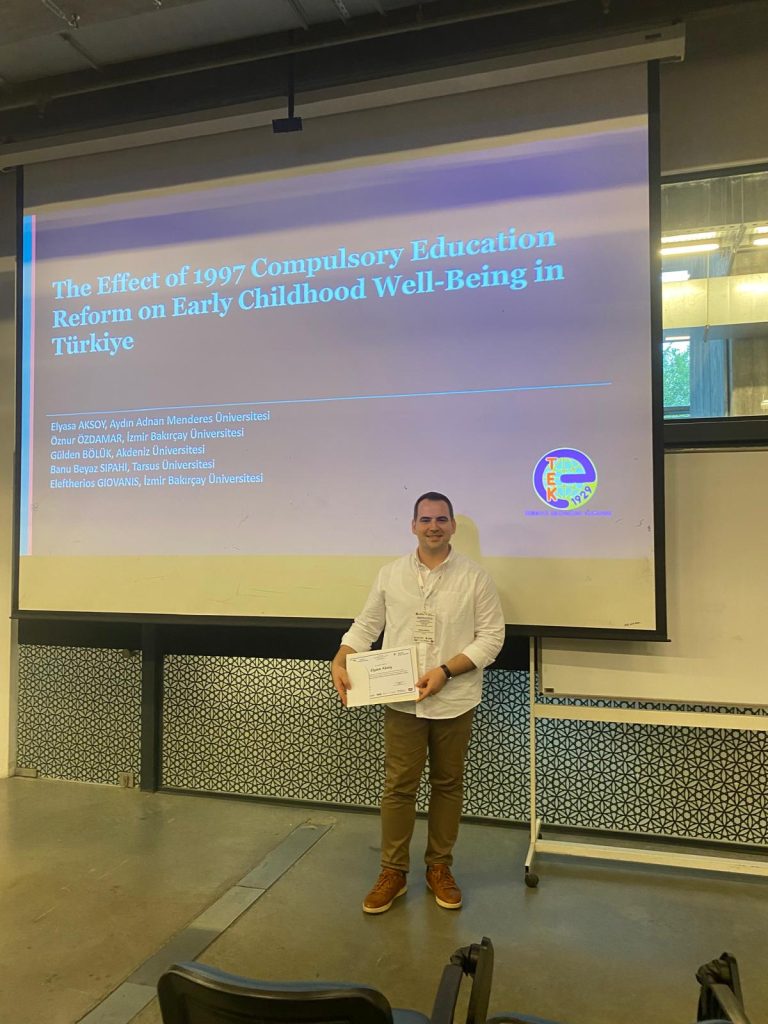
The Effect of 1997 Compulsory Education Reform on Early Childhood Well-Being in Türkiye
The Effect of 1997 Compulsory Education Reform on Early Childhood
Well-Being in Türkiye
Aydın Adnan Menderes University, Türkiye
elyasa.aksoy@adu.edu.tr
Öznur Özdamar
İzmir Bakırçay University, Türkiye
oznur.ozdamar@bakircay.edu.tr
Gülden Bölük
Akdeniz University, Türkiye
guldenboluk@akdeniz.edu.tr
Banu
Beyaz Sipahi
Tarsus
University, Türkiye
banubeyazsipahi@tarsus.edu.tr
Eleftherios
Giovanis
İzmir
Bakırçay University, Türkiye
eleftherios.giovanis@bakircay.edu.tr
Abstract
Parental education plays a critical role in early childhood development and well-being. This study examines the causal impact of the 1997 compulsory education reform in Türkiye on developmental outcomes of children aged 0–5, exploiting exogenous variation in mothers’ and fathers’ schooling induced by the reform. Using data from the 2022 Turkish Statistical Institute (TÜİK) Child Survey and a regression discontinuity design (RDD), we estimate the reform’s effects on various developmental and well-being indicators. In addition, we construct a Türkiye-specific UNICEF Early Childhood Development Index (ECDI) and assess the policy’s impact on this composite measure. The findings suggest that increases in parental education generate limited yet meaningful effects on key outcomes of child development. Maternal education is associated with partial improvements in some cognitive and self-care skills. Moreover, no significant relationship is observed between maternal education and children’s basic motor and language development indicators. Both mother’s and father’s education levels demonstrate a strong association with children’s eating habits, hygiene practices, and living conditions. In conclusion, the findings suggest that compulsory education reform affects child well-being through indirect channels such as childcare practices, nutritional preferences, and the home environment, within the framework of the intergenerational transmission mechanism of human capital.
Key Words: Compulsory education reform, parental education, child well-being, regression discontinuity design.
Jel Codes: I28, I31, J13.
[1]Correspondence: Department of Public Finance, Faculty of Political Science, Aydın Adnan Menderes University, Aydın, Türkiye. Phone: +90 256 220 49 84 ex: 4984, e-mail: elyasa.aksoy@adu.edu.tr
[2] This research was funded by the Scientific and Technological Research Council of Turkey (TUBITAK) under the Program 1001 with Project No. 312K521. The financial support received from TÜBİTAK does not mean that the context of the paper is approved in a scientific sense by TÜBİTAK. The authors are grateful for the financial support received.